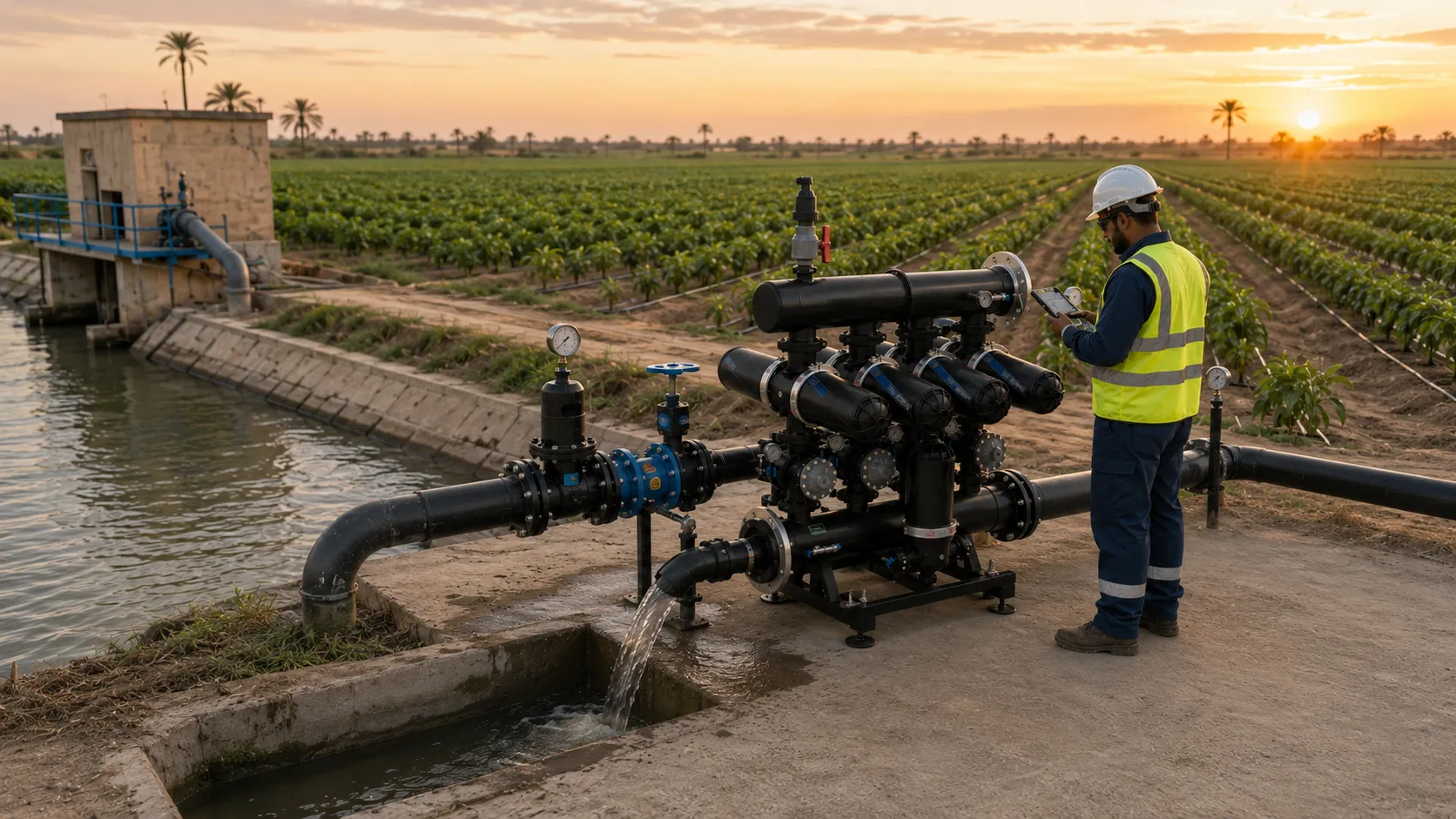
كيفية اختيار نظام الفلترة المناسب لشبكة الري
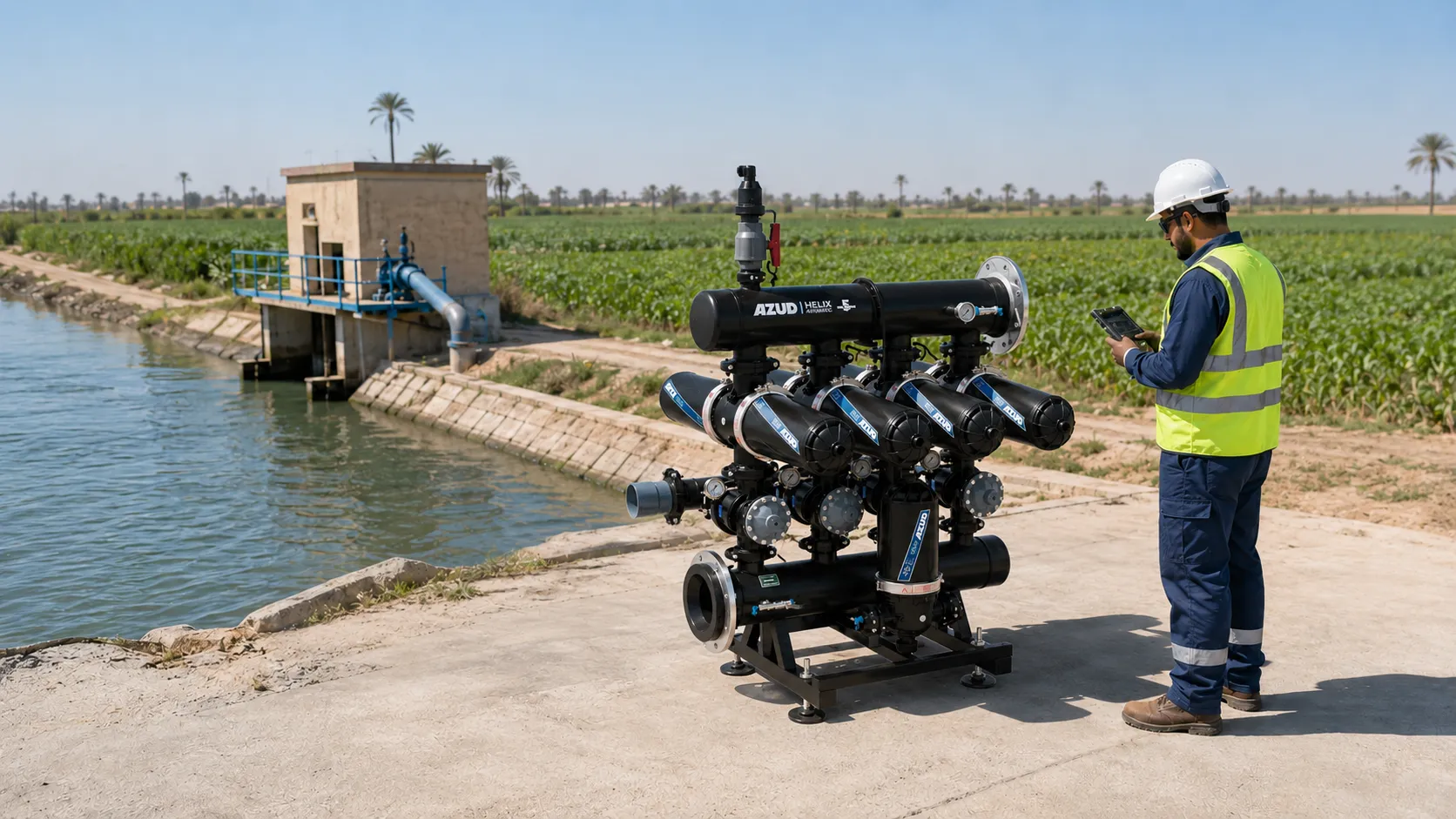
Filtration is the first line of protection for drippers, sprinklers, valves, and measuring devices. Incorrect filter selection can result in clogging, uneven irrigation, increased maintenance, and network downtime.
1. Identify the Water Source
The water source provides an initial indication of the expected contaminants.
Well Water
It may contain:
- Sand.
- Mineral deposits.
- Iron or manganese.
- Dissolved salts.
- Canal or Open-Reservoir Water
It may contain:
- Algae.
- Organic matter.
- Vegetation.
- Silt and suspended solids.
- Treated Wastewater
- It may contain fine or organic particles that require specific evaluation according to the treatment level and final application.
2. Conduct a Water Analysis
Visual inspection alone is not sufficient. Water that appears clean may contain fine particles that gradually clog emitters.
The analysis should identify:
- Contaminant types.
- Particle sizes.
- Suspended-solid concentration.
- Algae or organic matter.
- pH.
- Iron and manganese levels.
- Potential chemical precipitation.
3. Select the Appropriate Filter Type
Screen Filters
Screen filters use a filtering mesh and are suitable for many applications with limited amounts of inorganic particles.
Disc Filters
Disc filters use a stack of grooved discs that create multiple filtration paths. They can be effective when the water contains a mixture of contaminants.
Media Filters
Media filters are commonly considered where water contains significant organic loads, such as certain surface-water sources.
Some projects may require multiple filtration stages rather than one filter type.
4. Determine the Required Filtration Degree
The filtration degree should be selected according to the smallest water passage in downstream components, particularly drippers.
Finer filtration is not always better. Unnecessarily fine filtration can cause:
- Higher pressure loss.
- More frequent cleaning.
- Increased cost.
- Reduced operational efficiency.
- The objective is to protect the network without adding unnecessary hydraulic or maintenance demands.
5. Calculate the Required Flow Rate
The filter must be selected according to the maximum flow passing through it during operation.
Consider:
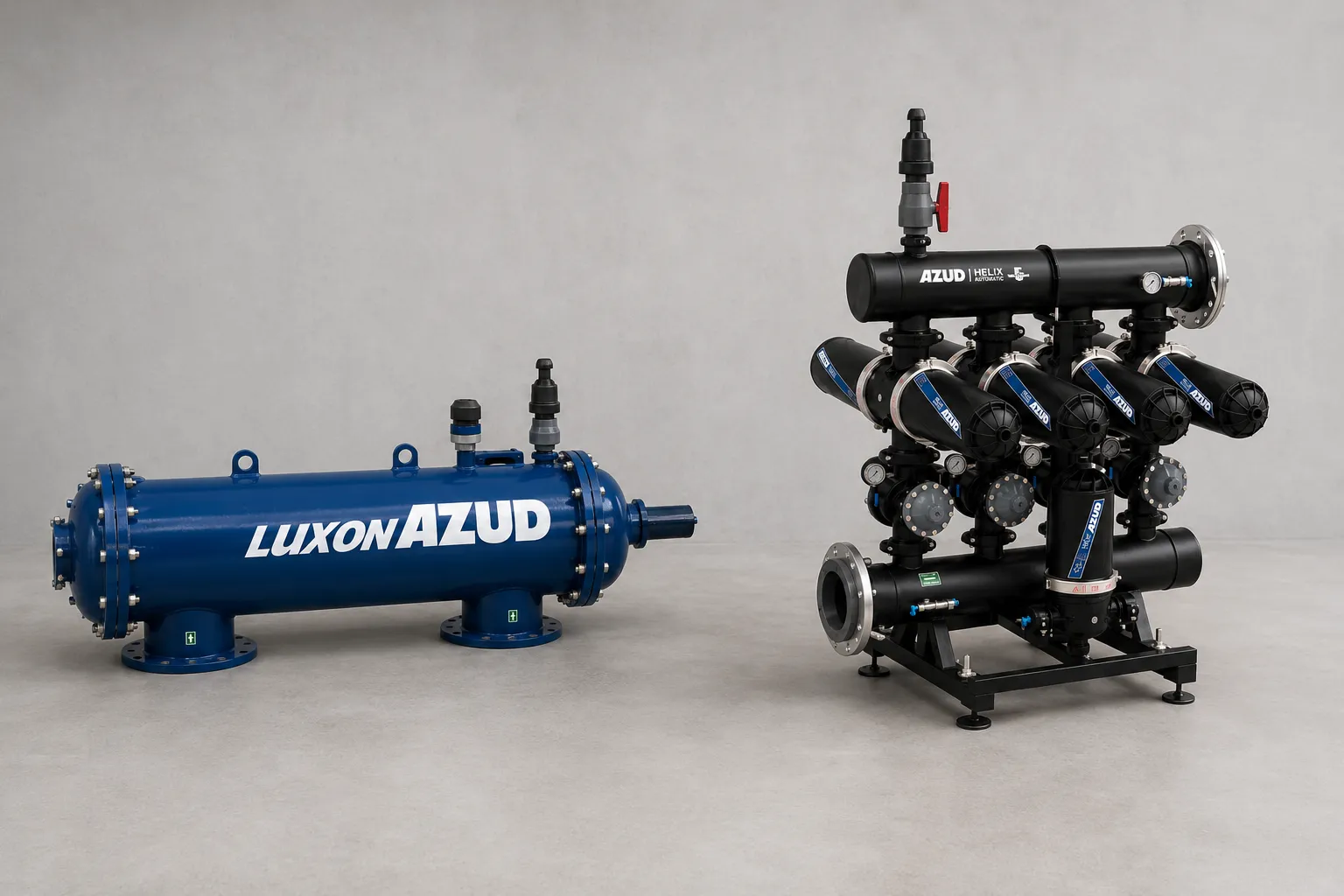
- Number of zones operating simultaneously.
- Flow requirement of each zone.
- Flow velocity through the filter.
- Expected pressure loss.
- Potential future expansion.
6. Review Pressure Loss
Every filter causes some pressure loss, which increases as contaminants accumulate.
The network should provide:
- Sufficient pressure downstream of the filter.
- Pressure measurement upstream and downstream.
- Cleaning initiation at the recommended differential pressure.
- Cleaning before complete blockage occurs.
7. Manual or Automatic Cleaning?
Manual Cleaning
It may be appropriate when:
- Flow requirements are limited.
- Contaminant levels are low.
- Operators are consistently available.
- Temporary system shutdown is acceptable.
- Automatic Cleaning
It may be more appropriate when:
- The network is large.
- Water quality changes frequently.
- Contaminant loads are high.
- Irrigation shutdown is difficult.
- Operational continuity is critical.
- The project aims to reduce manual intervention.
خلط Spray وRotor في القطاع نفسه.
Selecting a filter before analyzing the water.
Sizing the filter according to pipe diameter alone.
Ignoring pressure loss.
Selecting unnecessarily fine filtration.
Failing to provide pressure-measurement points.
Ignoring the water required for backwashing.
Failing to plan the disposal or reuse of cleaning water.
تأكد من:
أبعاد وشكل المنطقة.
- Water source.
- Water-analysis results.
- Contaminant type and size.
- Maximum flow rate.
- ضغط التشغيل.
- Required filtration degree.
- Permitted pressure loss.
- Cleaning method.
- Water available for cleaning.
- Installation space.
Conclusion: There is no single filter suitable for every network. Correct selection begins with water quality and ends with the project’s operating and maintenance requirements.