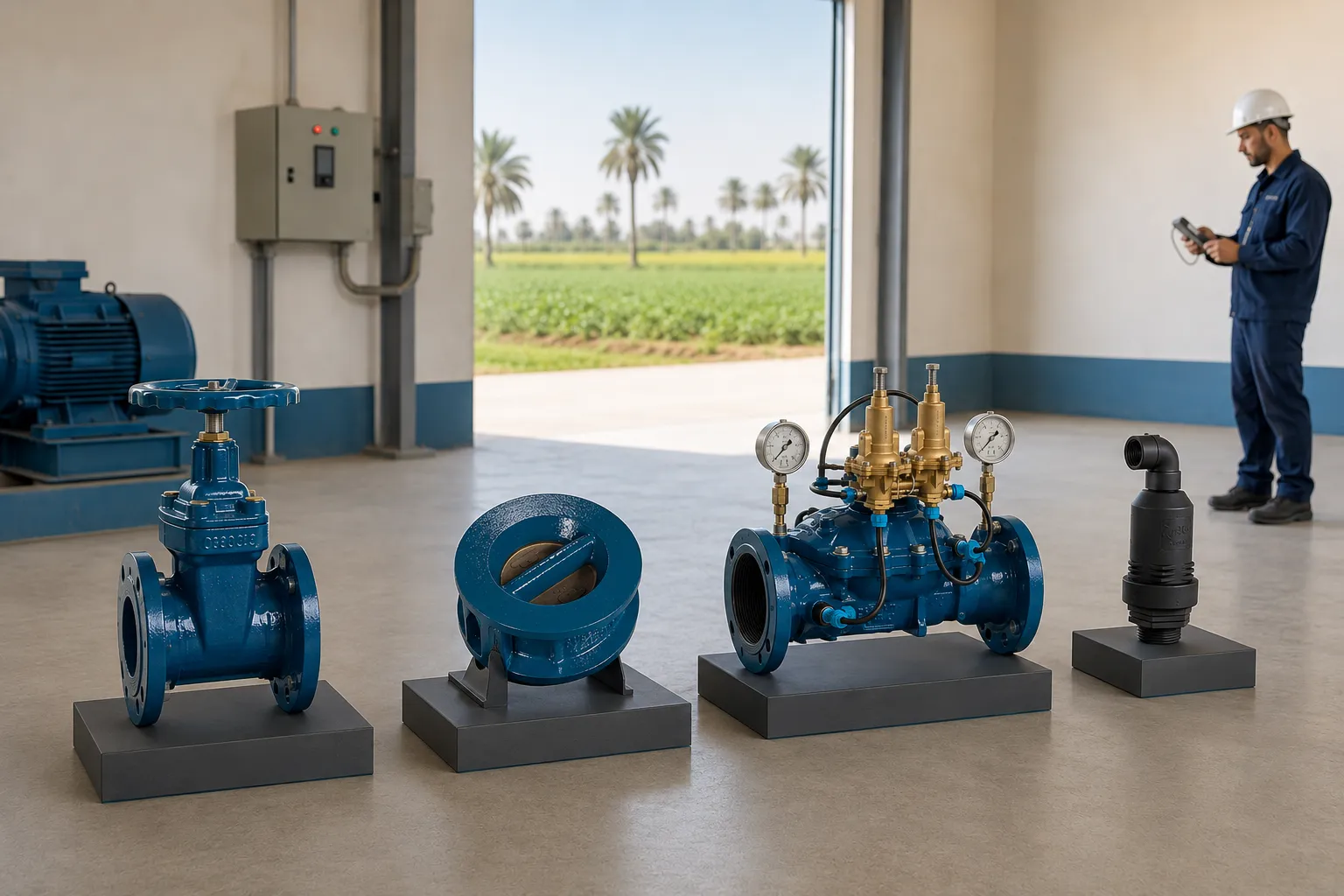
How to Choose the Right Valve for a Water or Irrigation Network
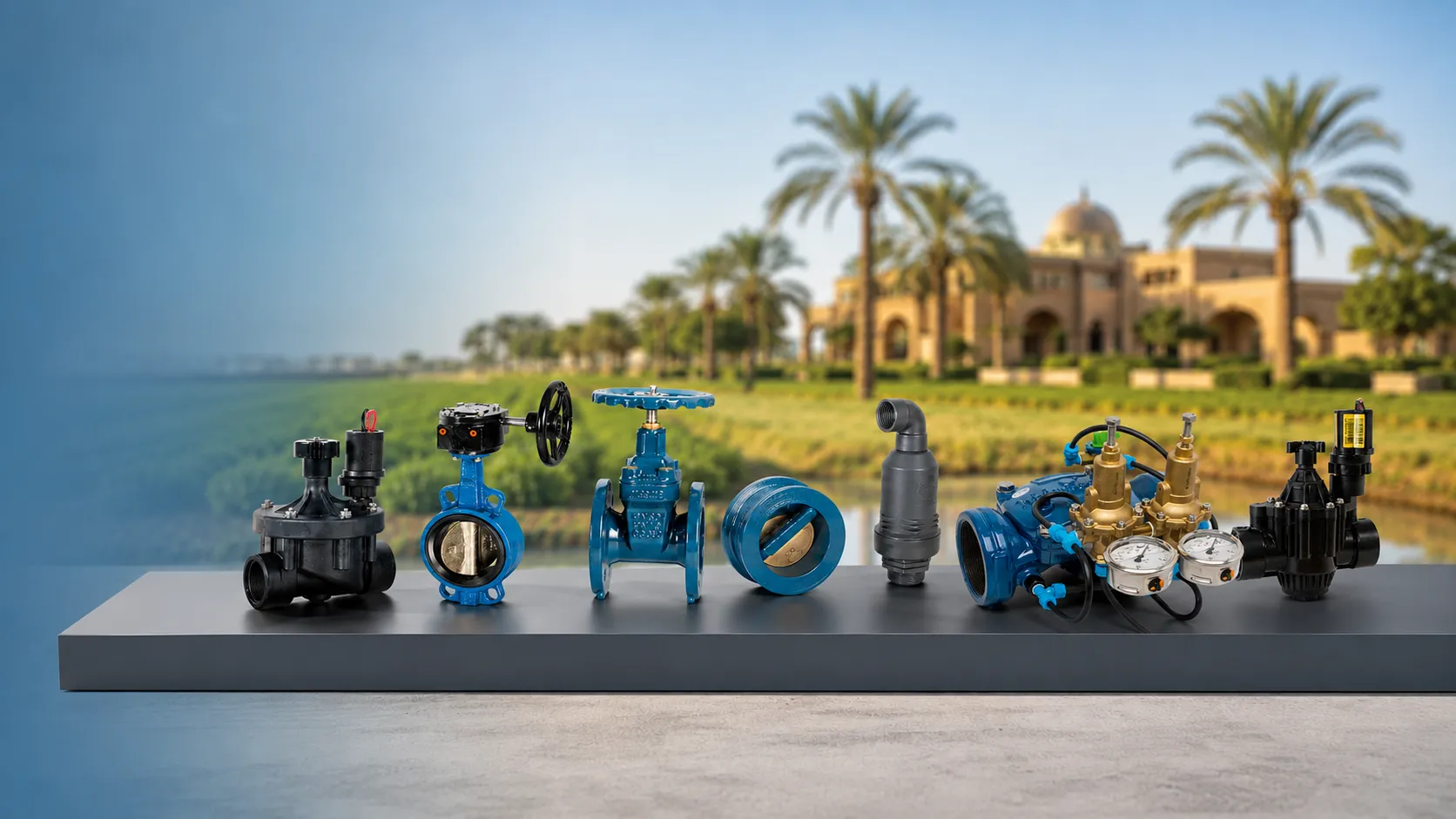
Not all valves serve the same purpose. Some are designed for isolation, while others regulate flow, control pressure, or prevent reverse flow. Selecting the wrong valve can create excessive pressure loss, operating difficulties, or premature failure.
1. Define the Valve’s Function
Before selecting the material or diameter, define the required function:
- Fully open or close the pipeline.
- Regulate flow.
- Reduce or stabilize pressure.
- Prevent reverse flow.
- Provide automatic control.
- Isolate a network section for maintenance.
- Release trapped air.
- Protect the network under specific operating conditions.
2. Understand the Main Valve Types
Gate Valve
Commonly used to isolate pipelines in fully open or fully closed positions. It is generally not intended for continuous flow regulation.
Butterfly Valve
Provides a compact design and is used in various diameters for isolation and certain control applications, depending on its design.
Ball Valve
Provides rapid opening and closing and is used in many mainline and branch applications.
Check Valve
Allows water to flow in one direction and helps prevent reverse flow.
Control Valve
Used to control pressure, flow, or level according to the valve design and control circuit.
Pressure-Reducing Valve
Reduces a higher inlet pressure to a more stable downstream pressure within the specified design conditions.
3. Determine the Diameter and Flow Rate
Selecting a valve based on pipe diameter alone may not be sufficient, particularly for control valves.
Review:
- Required flow rate.
- Water velocity.
- Pressure loss.
- Valve function.
- Minimum and maximum operating conditions.
- Potential cavitation or noise in applicable situations.

4. Review Operating Pressure
Confirm:
- Valve-body pressure rating.
- Compatibility of connections and flanges.
- Maximum static pressure.
- Actual operating pressure.
- Potential water hammer.
- Differential pressure across the valve.
5. Select the Appropriate Material
Material selection depends on:
- Water type and quality.
- Operating temperature.
- Salts or chemicals in the water.
- Installation environment.
- Sun exposure or underground installation.
- Pressure and mechanical loads.
Possible materials include:
- Ductile iron.
- Brass.
- Stainless steel.
- PVC-U.
- Engineering polymers.
6. Select the Connection Type
Connections may include:
- Threaded.
- Flanged.
- Welded.
- Socket.
- Compression.
- Other application-specific methods.
- The connection must be compatible with the pipe material, pressure rating, and installation method.
7. Consider Operation and Maintenance
Ask:
- Is the valve manual or automatic?
- Can it be accessed easily?
- Is there sufficient space for removal and maintenance?
- Does it require a valve box or chamber?
- Are spare parts available?
- Can its open or closed position be identified easily?
- How will it be operated during an emergency?
Common Mistakes to Avoid
Using a gate valve for continuous flow regulation.
Selecting the valve based only on pipe diameter.
Ignoring differential pressure.
Using a material unsuitable for the water quality.
Installing the valve in an inaccessible location.
Ignoring the required flow direction.
Failing to consider water hammer.
Selection Checklist
Confirm:
- Required valve function.
- Pipe diameter.
- Flow rate.
- Upstream and downstream pressure.
- Water type.
- Operating temperature.
- Suitable valve material.
- Connection type.
- Operating method.
- Installation and maintenance conditions.
Conclusion: Correct valve selection begins with its required function. The size, material, connection, and control method should then be determined according to the hydraulic and operating conditions.