
Filtration Systems
Reliable Irrigation Starts Before Water Reaches the Emitters
Filtration is not an accessory within an irrigation network. It is the first line of protection for emitters, valves, meters, pumps and all downstream equipment.
ECS provides manual, semi-automatic and automatic filtration solutions selected according to the water source, contaminant type, required flow, operating pressure, filtration degree and cleaning requirements.
The Filtration Challenge
When Water Quality Changes, the Entire Network Is Affected
Irrigation water may contain sand, silt, organic matter, algae and other suspended particles. Without a correctly selected filtration system, these contaminants accumulate inside emitters, valves and pipelines, reducing network efficiency and increasing maintenance requirements.
Common Challenges
- Clogged drippers and sprinklers.
- Uneven water distribution between irrigation sectors.
- Seasonal changes in contaminant type and concentration.
- Excessive pressure loss caused by incorrect filter selection or sizing.
- Frequent manual cleaning.
- Irrigation interruptions during maintenance.
- Excessive backwash-water consumption.
- Insufficient protection for pumps, meters, valves and downstream equipment.
- Reduced service life of irrigation-network components.
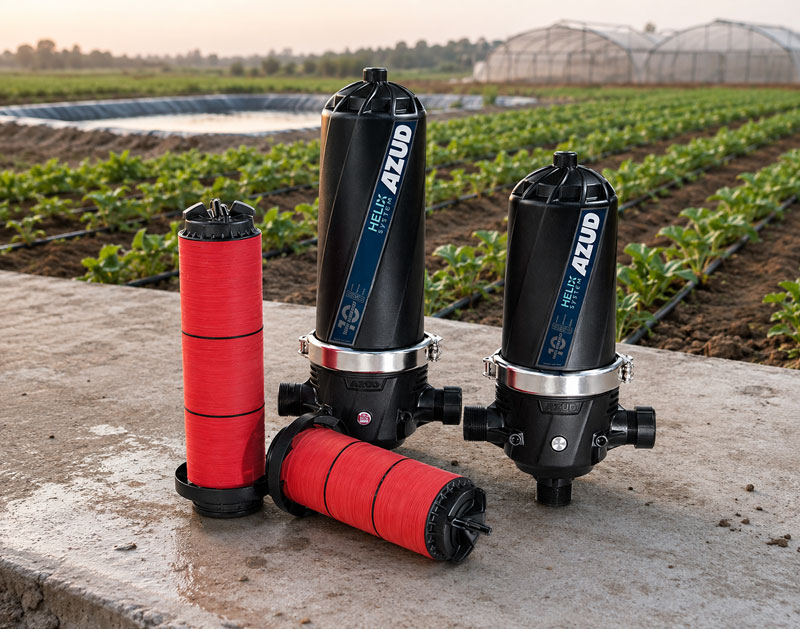
The ECS Solution
Filtration Designed Around Real Operating Conditions
Selecting a filtration system involves more than matching the connection size or nominal flow rate. ECS starts by evaluating the water source, contaminant characteristics, required flow, operating pressure, filtration degree, available backwash water and desired level of automation.
Based on this information, we compare disc and screen filtration technologies and determine the appropriate number of filter elements, cleaning method, manifold configuration, valves and control requirements.
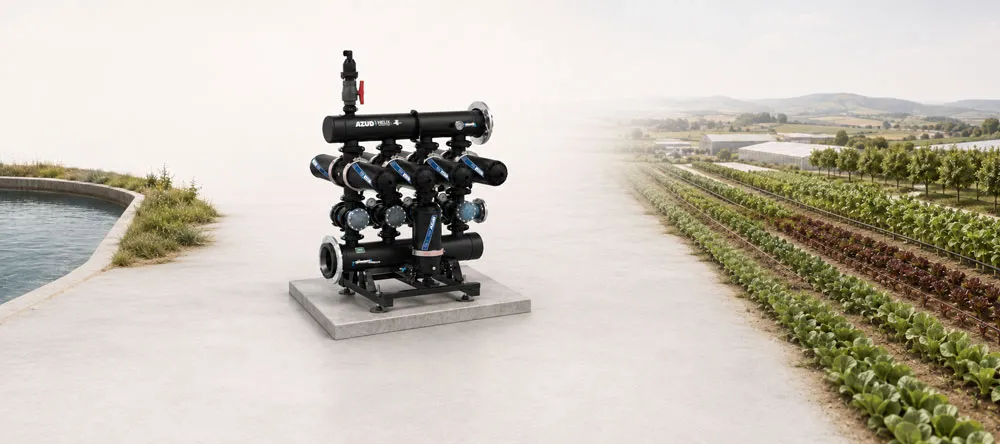
From Water Source to a Protected Irrigation Network
Water Source
Filtration
Pressure Monitoring and Cleaning
Protected Irrigation Network
- Remove contaminants before they enter the network.
- Maintain the required filtered-water quality.
- Monitor differential pressure across the filters.
- Perform manual, semi-automatic or automatic cleaning.
- Maintain clean-water delivery to irrigation sectors.
- Protect emitters, valves, meters and pumps.
Filtration Solution Portfolio
From Straightforward Manual Protection to Automatic Self-Cleaning Stations
ECS provides a scalable range of AZUD filtration solutions for different water sources, flow rates, contaminant loads and operation and maintenance requirements.
Manual Disc and Screen Filters
Simple and Dependable Irrigation-Network Protection
Manual filters provide a cost-effective solution for small and medium irrigation systems where contaminant loads are limited and periodic cleaning can be performed by the operating team.
Disc or screen technology can be selected according to contaminant characteristics and the required filtration degree.
Suitable Products
- AZUD MODULAR 100
- AZUD MODULAR 300
- AZUD AGL
- AZUD HELIX SYSTEM
Key Benefits
- Straightforward and dependable operation.
- Disc and screen filtration options.
- Effective removal of suspended particles.
- Easy access to the filtration element.
- Limited maintenance requirements.
- Competitive initial investment.
- Suitable for multi-filter manual configurations.
Best Suited For
Small and medium farms, irrigation networks with relatively stable water quality and projects where regular manual cleaning is practical.
Semi-Automatic Screen Filtration
Easier Cleaning with Straightforward Operation
Semi-automatic filtration provides improved cleaning convenience compared with conventional manual filters while maintaining a simple configuration and practical operating cost.
The cleaning mechanism helps remove accumulated contaminants without fully dismantling the filter during every cleaning cycle.
Suitable Products
- AZUD SPIRAL CLEAN
Key Benefits
- Dependable screen filtration.
- Semi-automatic cleaning.
- Reduced maintenance time.
- Less frequent dismantling of the filtration element.
- Compact and straightforward design.
- A practical intermediate step between manual filtration and full automation.
Best Suited For
Projects that require more frequent cleaning but do not need a fully automatic filtration station.
Automatic Disc Filtration Systems
Continuous Protection with Automatic Backwashing
AZUD HELIX AUTOMATIC systems use three-dimensional disc filtration to remove organic and inorganic suspended contaminants from irrigation water.
Filter elements are cleaned sequentially, allowing the system to continue supplying filtered water during the backwashing cycle.
Suitable Products
- AZUD HELIX AUTOMATIC 200
- AZUD HELIX AUTOMATIC 4DCL
- AZUD HELIX AUTOMATIC FT
- Air-assisted backwash configurations for applications with high organic loads.
Key Benefits
- Surface and depth filtration through three-dimensional discs.
- Sequential automatic backwashing.
- Continued filtered-water supply during cleaning.
- High capacity for variable contaminant loads.
- Suitable for water containing organic matter or organic fertilizers.
- Reduced backwash-water consumption.
- Reduced energy and labour requirements.
- Modular station configurations for different flow capacities.
Best Suited For
Medium and large farms, canals, reservoirs, water with high organic loads and irrigation networks requiring continuous operation with limited manual intervention.
Automatic Self-Cleaning Screen Filtration
High Filtration Capacity with a Compact Footprint
AZUD LUXON systems use a screen filtration element that is cleaned automatically by suction nozzles moving across the screen surface, removing contaminants without interrupting the filtered-water supply.
Different configurations are available for agricultural and industrial applications and for high-flow installations.
Suitable Products
- AZUD LUXON LDB
- AZUD LUXON MFH
- AZUD LUXON LXE
Key Benefits
- Effective removal of inorganic suspended particles.
- Automatic cleaning using suction nozzles.
- Continuous filtered-water supply during cleaning.
- Low cleaning-water consumption.
- Compact footprint relative to filtration capacity.
- Robust construction for continuous operation.
- Automatic operation and control.
- Suitable for high-flow applications.
Best Suited For
Large agricultural projects, pumping stations, well water containing sand and inorganic particles and applications requiring high filtration capacity with automatic operation.
Compare Filtration Solutions
| Solution Category | Filtration Technology | Cleaning Method | Best Application |
|---|---|---|---|
| Manual Filters | Disc or screen | Manual | Small and medium irrigation networks |
| SPIRAL CLEAN | Screen | Semi-automatic | Reduced cleaning time with straightforward operation |
| HELIX AUTOMATIC | Three-dimensional discs | Automatic backwashing | Organic and variable contaminant loads |
| LUXON | Screen | Self-cleaning suction nozzles | High flow rates and inorganic suspended particles |
Final selection must be based on water analysis, required flow, operating pressure, filtration degree and site cleaning conditions.
Filtration-System Selection Criteria
Every Water Network Requires a Different Configuration
Water Source
Contaminant characteristics differ between wells, canals, reservoirs and treated water. Selection therefore begins with the water source and its operating conditions.
Contaminant Type
The appropriate technology is selected according to the presence of sand, silt, organic matter, algae or a combination of contaminants.
Required Flow
Filters, manifolds and the number of filtration elements are sized according to the design and maximum expected flow rates.
Operating Pressure
The system must have sufficient pressure for normal operation and cleaning while maintaining the required downstream irrigation pressure.
Filtration Degree
The micron rating is selected according to the requirements of the emitters, sprinklers and downstream equipment.
Allowable Pressure Loss
Pressure loss must remain within limits that allow the irrigation network to operate efficiently.
Cleaning Method
Manual, semi-automatic or automatic cleaning is selected according to contaminant load, cleaning frequency and labour availability.
Backwash-Water Availability
The quantity and quality of available cleaning water are evaluated when selecting the filtration and backwashing technology.
Operation and Maintenance
Filter accessibility, spare-part availability and the operating team’s experience must be considered during station design.
Why Correct Filtration Is an Investment in the Network
- Reduce dripper and sprinkler blockage.
- Improve water-distribution uniformity.
- Protect valves, meters and pumps.
- Reduce manual cleaning and maintenance.
- Minimise irrigation interruptions.
- Extend the service life of irrigation equipment.
- Optimise backwash-water and energy use.
- Maintain stable performance when water quality changes.
- Support continuous operation in large agricultural projects.
How ECS Supports the Project
- Review the water source and available water analysis.
- Review required flow and operating pressure.
- Identify the expected contaminant type and load.
- Define the required filtration degree.
- Compare disc and screen technologies.
- Select the appropriate cleaning method.
- Size the number of filter elements and manifolds.
- Review backwash and control requirements.
- Provide technical data and performance information.
- Coordinate technical proposals, commercial offers and supply requirements.
- Support installation, commissioning and maintenance according to the project scope.
Frequently Asked Questions
What information is required to select a filtration system?
We need the water source, available water analysis, required flow, operating pressure, filtration degree, emitter or sprinkler type, available backwash water and the required level of automation.
When should disc filtration be used instead of screen filtration?
The decision depends on contaminant type and operating conditions. Disc filters provide both surface and depth filtration and are well suited to organic loads or mixed contaminants. Screen filters are suitable for many inorganic-particle and sand applications, particularly when combined with suction-cleaning systems. Final selection should be based on actual water data.
How is the micron rating determined?
The filtration degree is selected according to the internal passage size of the emitters or downstream equipment, together with the type and size of particles in the water source.
When should a project move from manual to automatic filtration?
Automatic filtration becomes more appropriate when cleaning is frequent, water quality changes regularly, labour and interruption costs increase or continuous system operation is required.
Can a new filtration system be integrated into an existing irrigation network?
Yes. ECS reviews the existing flow, pressure, connections, available space and control system to ensure compatibility with the new filtration station.
What initiates an automatic cleaning cycle?
Cleaning can be initiated by differential pressure across the filters, a programmed time interval or a manual command from the controller, depending on the system configuration.
Does filtered-water supply continue during backwashing?
In multi-unit stations, filter elements are normally cleaned sequentially. This allows the remaining units to continue supplying filtered water during the cleaning cycle, subject to the station design.
What maintenance is required?
Maintenance includes checking differential pressure, inspecting filtration elements and valves, verifying controller and cleaning-cycle operation, cleaning drain lines and replacing wear components according to operating instructions.
Need Help Selecting the Right Filtration Technology?
Send the ECS team your water source, available water analysis, required flow rate, operating pressure, filtration degree and irrigation-network details.
We will help determine the appropriate filtration technology, number of units, cleaning method and station configuration for dependable protection and more stable operation.